
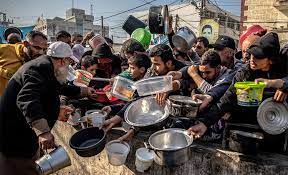
The food crisis in Gaza continues, and the people of Gaza continue to suffer from systematic starvation, despite the issuance of the ceasefire agreement, but humanitarian aid does not reach all families in Gaza, in addition to high prices, which makes it difficult to provide food security for families in Gaza.
Causes of the food crisis in Gaza
Food insecurity in the sector continues to worsen, making food a scarce and expensive commodity and threatening the lives of the population, especially children and women. The reasons for the persistence of this crisis are numerous and include overlapping political, economic and humanitarian factors.
1. The ongoing Israeli blockade
The blockade imposed on the Gaza Strip since 2007 is one of the main reasons for the continuing food crisis, as it prevents the regular entry of essential materials, fuel and agricultural goods. This blockade has led to almost total paralysis in local production, and significant difficulties in importing food or exporting agricultural products, creating an almost total dependence on humanitarian aid.
2. Destruction of agricultural infrastructure
Agricultural land, water and irrigation systems, and animal farms have been extensively destroyed by repeated shelling. This has led to a sharp decline in local production of vegetables, grains and poultry, leaving the sector unable to achieve food self-sufficiency even in its simplest forms.
3. Supply chain disruption
As a result of the extensive destruction of roads, ports and crossings, the movement of food within the sector has become a complex and slow process. Frequent power and fuel outages also hamper storage and cooling, damaging food before it reaches consumers.
What is the impact of the blockade on the food crisis in Gaza?
The blockade imposed on the Gaza Strip since 2007 is one of the most prominent factors that have exacerbated the food crisis and continues to this day, especially with the October 7 war. This comprehensive blockade imposed by the Israeli occupation authorities on the crossings, borders and sea has directly affected the various stages of the food system, from production to transport, storage and distribution.

Read more about the impact of the blockade on the Gaza Strip
1. Gaza food crisis: restricting the entry of basic foodstuffs
The blockade imposes strict restrictions on the entry of goods and foodstuffs, especially those classified as so-called "dual-use goods," such as agricultural fertilizers and equipment for production. This leads to a persistent shortage of some food items and a significant rise in prices due to limited supply. Shipments of food are often prevented on security grounds, making food supplies unstable and subject to disruption at any time.
2. Gaza food crisis: crippling the agricultural sector and local production
The blockade has denied farmers access to their land near the eastern and northern borders, one of the most fertile agricultural lands in Gaza. Large areas of land have also been destroyed by shelling or soil erosion. With the entry of agricultural equipment, spare parts and irrigation materials prevented, local production declined sharply, increasing dependence on imported food or aid.
3. Gaza food crisis: rising prices and declining purchasing power
As a result of reduced supply and higher transport and production costs, food prices have risen significantly beyond the purchasing power of the majority of the population.
4. Gaza food crisis: disruption of supply and distribution chains
Restricting the movement of goods within the Strip is one of the most prominent manifestations of the blockade, as the closure of crossings from time to time delays the entry of fresh food items such as vegetables and dairy, leading to damage. Persistent fuel shortages also hamper intra-sector transportation and distribution, affecting the operation of bakeries and food factories that rely mainly on electricity and fuel.
How has the war affected food security and the food crisis in Gaza?
The 7 October war on the Gaza Strip is considered one of the most destructive wars in the history of the Palestinian-Israeli conflict, as its effects were not limited to physical destruction only, but extended to all humanitarian and living aspects, especially food security. Within a few months, Gaza had become a disaster zone, suffering severe food, water and energy shortages, with almost complete collapse of production capacity and infrastructure.
1. Destruction of agricultural infrastructure and local production
Large tracts of farmland in the north, center and south of the Strip were directly bombed, destroying crops, uprooting trees, and killing large numbers of livestock and poultry. Irrigation systems, wells, warehouses and agricultural equipment were destroyed, making the continuation of agriculture almost impossible.
As a result, local production has fallen to its lowest level in years, depriving residents of fresh vegetables, fruits and animal products that were a major source of daily food.
2. Disruption of food supply and distribution chains
The war has led to a near-total paralysis of transport within and between the Strip, with roads and bridges destroyed and cities and towns cut off, making it almost impossible to get food to those in need. Prolonged closures have also prevented the entry of trucks carrying humanitarian aid, leaving thousands of tons of food stuck at the border.
Even after some aid had entered, humanitarian organizations faced enormous difficulties in distributing it due to constant shelling and insecurity, which made food access to civilians limited and irregular.
Read more about Malnutrition in Gaza
3. Power and fuel outages and their impact on food storage
Gaza’s only power plant has been shut down due to fuel shortages and repeated shelling, resulting in long hours of power outages. As a result, refrigerators and stores have been disrupted, and large quantities of food have been destroyed due to the inability to cool them. Shortages of fuel have also put bakeries and food and water factories out of business, with basic goods such as bread and milk disappearing from markets for extended periods.
4. High price
Due to supply disruptions and the destruction of markets and stores, the prices of remaining food items have risen to fanciful levels. With business stalled and economic infrastructure destroyed, most residents lost their sources of income, leaving purchasing power virtually non-existent. Thus, even when food is available in some areas, many cannot afford to buy it, exacerbating hunger and food shortages.
5. Health system collapse and worsening malnutrition
The collapse of the health sector has exacerbated the food crisis, as hospitals and health centers are no longer able to provide therapeutic feeding services for children and patients. Vitamin and nutritional deficiencies have also led to an increase in acute malnutrition, especially among the most vulnerable. International organizations report high rates of anaemia, protein deficiency and muscle atrophy in children.

