
Gaza is one of the oldest cities in the world, with its largest governorate and its political and economic center.
They include the following governorates:
- Khan Yunis province
- Rafah Governorate
- Northern Gaza Governorate
- Central Gaza Governorate
The city is the capital of the center of the brigade, which bears its name "Gaza Brigade" which is bordered on the west by the Mediterranean Sea and on the south by the Egyptian Arab Republic.
It is the birthplace of Imam Shafi'i, may Allah be pleased with him, the owner of Shafi'i, one of the four sects.[1].
What are the advantages of Gaza?
Strategic Location
Gaza is considered the gateway to Asia and the gateway to the African continent by virtue of the geographical location between Egypt and the Levant (Syria, Jordan, Palestine and Lebanon), and between the continents Asia and Africa.
Economic importance
The importance of Gaza throughout history lies as a transportation point and the main link between Asia and Africa and a commercial convoy station and therefore a global center.
Agriculture in Gaza
The results of the agricultural census for 2020/2021 indicated that the total area planted with horticulture trees, vegetables and field crops such as:
- Lemon trees and acid trees.
- Olive trees.
- cucumbers and vegetables.
Due to the conflict in Gaza, direct daily losses in agricultural production as a result of the production halt amounted to US$ 2 million.[2].
As a result, the Sawaed Palestine Foundation has established a campaign to support the reconstruction and cultivation of agricultural areas.
The total land area is about 117,000 dunams, with Khan Yunis accounting for 32% of this area, while northern Gaza accounts for 29%. In addition, the area under cultivation in northern Gaza is estimated at 34,000 dunams, which have been bulldozed and destroyed. Much of this land has also been rendered uncultivable by the large quantities of explosives dropped on it.
Related article: Helping the Vulnerable in Gaza
Tourist and historical attractions
the Great Omari Mosque

Al Omari Mosque is the oldest mosque in Gaza City, located in the heart of Old Gaza near the Old Souk.
The mosque features 38 columns of beautiful and durable marble, which reflect the splendor and beauty of the city’s ancient architecture.
The mosque was named after the caliph Omar ibn al-Khattab, in honor of his role in transforming the building into a mosque and making it Islamic.
Moroccan Mosque

This ancient mosque is located in the stairwell, within the stair lane, and was established in the 9th century AH. He was taken as a corner by the good guardian Sheikh Mohammed of Morocco, which led to his fame with him. When the sheikh died, he was buried in a large cave beneath the mosque's iwan, and a tomb was built for him in his courtyard as a sign of his burial place, with an inscription of his death date of 864 AH.
the Greek Orthodox Church

It is worth mentioning that this church is located in the Zeitoun neighborhood, and its foundation dates back to the beginning of the fifth century AD while the current buildings date back to the twelfth century AD.
The church is characterized by its huge walls supported by marble and granite columns placed horizontally to strengthen the structure, in addition to stone shoulders that enhance its durability. The church underwent a renovation in 1856. In the northeast corner is the tomb of St. Porfirios, who died in 420 AD, giving the place great religious and historical value.
Barouk Castle

The castle was completed in 789 AH (1387 AD) and was built as an integrated government complex. The castle is characterized by its fortress and high walls, and includes a mosque and a well, as well as a hostel to receive travelers and a stable for horses.
Ibrahim al - Khalil
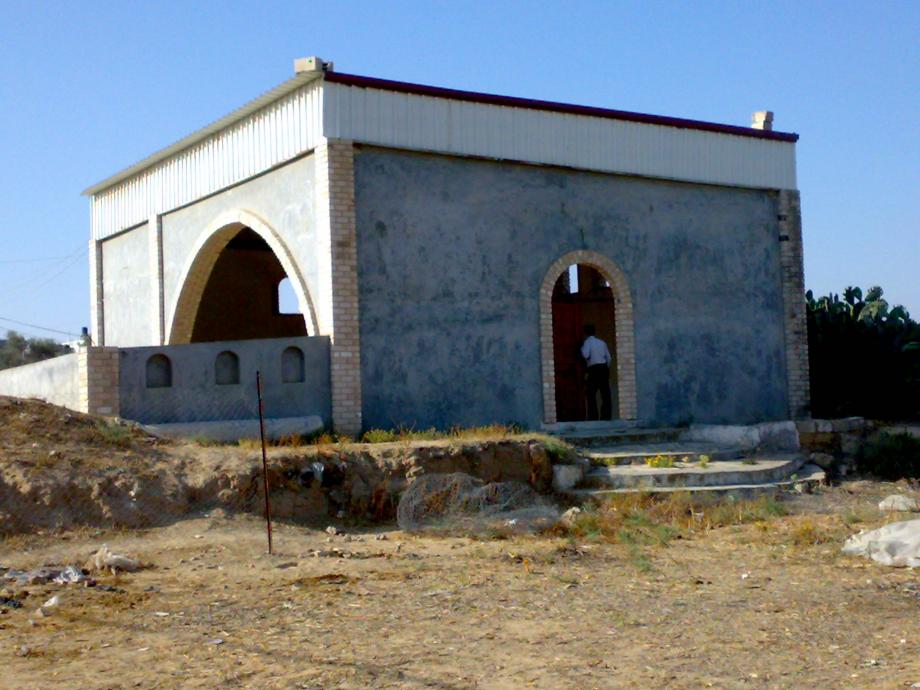
It is located in the large village of Abasan where there is a colorful mosaic floor characterized by its beauty and variety of drawings. These drawings include birds, plant leaves, and decorative scrolls, as well as the writings and decoration of the swastika known as the "fabricated". This mosaic floor dates back to 606 AD.
Related article: Suffering in northern Gaza

