
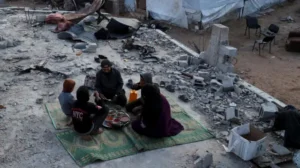
Gaza is witnessing the month of Ramadan amid the rubble under difficult conditions, where the population still faces violations of the ongoing war against them, comes Ramadan on Gaza has turned into rubble, and the food crisis has worsened to the point of famine in some areas in Gaza.
The humanitarian situation in Gaza during Ramadan
Securing food has become a daily challenge for hundreds of thousands of Palestinians in Gaza. Gaza’s markets, despite trying to offer Ramadan goods, are seeing prices soar that many basic goods are out of reach. Residents are hoarding cans and cheese in an attempt to secure their needs amid instability, and are deeply concerned about where their food is coming from in the coming days.
Around one million people live in tents in the deserted areas and western camps. These tents, which have become the only refuge for many after the destruction of their homes, lack the basics of a decent life, where the displaced lack clean water, electricity and sanitation. The constant displacement and loss of shelter increase the burden of Ramadan, as people find themselves trying to revive the holy month in harsh conditions.
Food security is one of the most important issues related to the humanitarian situation in Gaza during Ramadan, as many families have difficulty in securing integrated breakfasts and suhoor. The high prices of basic goods increase the pressure on the family budget, prompting some to reduce quantities or dispense some necessary items. Food support campaigns become a key element in reducing the worsening of the crisis. In addition to the food challenges, Gaza is also facing increasing pressures on basic services such as electricity, water and health care.
The persistence of difficult economic conditions is reflected in the stability of the family and its ability to meet the needs of its members. With the rising cost of living, many families are faced with difficult choices regarding the distribution of their limited resources between food, medicine, bills and other obligations. Ramadan makes these challenges even more evident, given its special nature and additional requirements.
Read more about Ramadan Humanitarian Campaigns for Gaza
Impact of the blockade on food in Gaza during Ramadan
The blockade of Gaza is a key factor affecting food security and the availability of food in local markets. With restrictions on the movement of goods and crossings, the sector faces complex challenges related to the flow of goods, price stability, and the ability of families to meet their daily needs.
1. Commodity entry restrictions
One of the most visible effects of the blockade is restrictions on the entry of raw materials and food commodities. When shipments are delayed or restrictions are imposed on certain types of goods, the supply on the market declines, leading to shortages of some basic items such as flour, oils, feed, and fresh produce. This restriction directly affects the stability of supply chains within the sector.
2. High Prices and Market Instability
As a result of limited supply and high transport and storage costs, markets are experiencing price fluctuations. This directly affects households’ purchasing power, especially in light of low income. With any additional disruption to crossing traffic, prices may rise abruptly, adding to the financial burden on Gazans.
3. Decline in domestic production
Restrictions on the entry of raw materials and agricultural inputs, such as seeds, fertilizers, and feed, affect the agricultural and livestock sector. As domestic production declines, the need for imports increases, compounding the impact of restrictions on crossings.
4. Direct impact on household food security in Ramadan
All of these factors lead to a decline in food security, with some households being forced to reduce or eliminate some basic items. This is most evident in low-income groups, which depend partly or entirely on humanitarian assistance for their food needs.
How do children in Gaza cope with the current Ramadan weather?
With the advent of Ramadan, children in Gaza are experiencing a different atmosphere that blends the spirituality of the holy month with the difficult humanitarian reality. Despite the economic and living challenges, children try to interact with Ramadan in their own way, drawing their energy from the family atmosphere and social customs associated with the holy month. In difficult economic conditions, many children are aware of their family’s material reality, which makes them better able to adapt to the simplicity of Ramadan manifestations inside the home. Decorations or festive manifestations may be limited to limited possibilities, but children learn to interact with these atmospheres with their own creativity, whether through making a handmade table or sharing.
Children are keen to fast for specific hours depending on their age and ability, and feel accomplished when completing a day of fasting or part of it. They also participate in prayers at home or in mosques when conditions are right, as well as follow Ramadan programs and religious activities that strengthen their bond with the holy month. Despite attempts at adaptation, children remain the most vulnerable to public conditions, both in terms of anxiety resulting from living conditions.
Read more about the importance of supporting Gaza in Ramadan

